
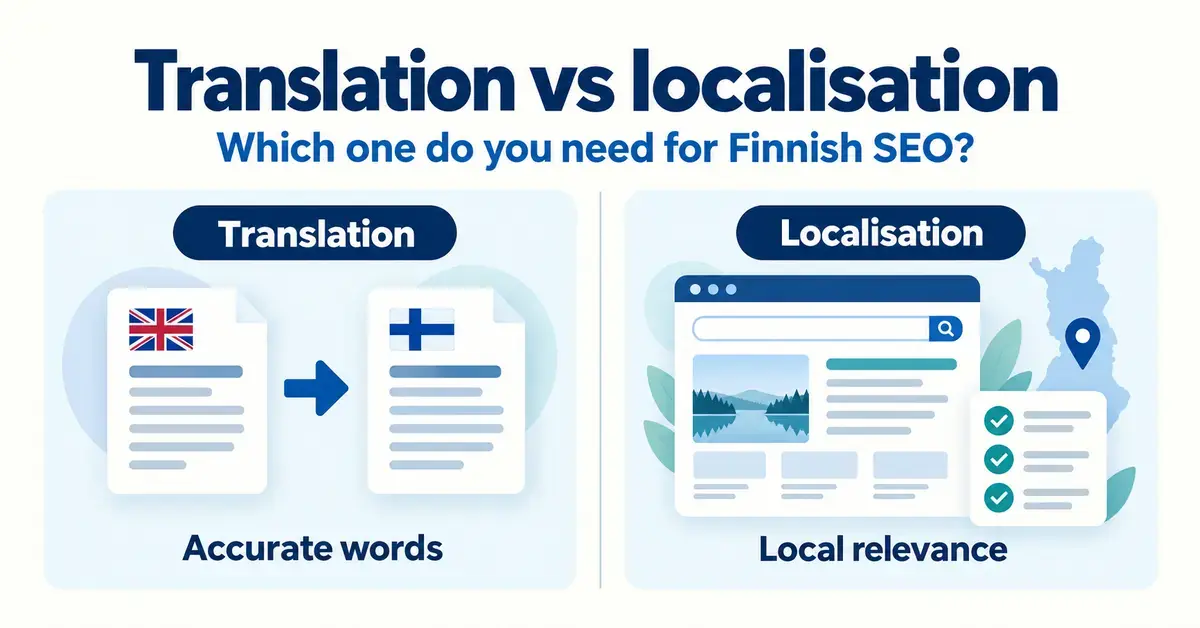
Translation changes the words of a text into Finnish. Localisation changes the whole page so it works for Finnish readers and Finnish search. That includes the keywords, formats, examples and tone, as well as the words. For pages that need to rank in google.fi and convert Finnish visitors, localisation is usually the better choice. Plain translation still has a place for legal, technical and support content.
This guide explains the difference, what each approach means for SEO, and how to decide page by page. It also covers whether English-language content can work on a Finnish site. For the wider picture, see the pillar guide to Finnish content localisation.
What is the difference between translation and localisation?
Translation carries meaning from one language to another. Localisation adapts the content to a specific market. A good translation is accurate. A good localisation reads as if it were written in Finland for Finns.
Translation
Translation turns the source text into correct Finnish while keeping its structure and meaning. A professional translator makes sure nothing is lost or added. The result can still feel foreign. The examples, units, humour and search terms stay those of the original market.
Localisation
Localisation starts from the translation and then adapts anything that doesn’t fit Finland. That includes:
- the keywords
- date and price formats
- how the reader is addressed
- examples and brand references
- images and calls to action
- legal wording
The goal is a page a Finnish reader doesn’t notice was adapted.
Transcreation and native writing
Transcreation goes a step further. It keeps the intent of a message but rewrites it freely in Finnish. It is used for slogans, headlines and campaigns, where a literal version would fall flat. Native writing skips the source text altogether: a Finnish writer creates the page from a brief.
Machine translation
Machine translation uses software such as DeepL, Google Translate or large language models to translate automatically. It is fast and cheap, but Finnish is hard for these tools. The risks are covered in the guide to using AI to write Finnish content.
Four ways to produce Finnish content
What each approach changes, and what it means for SEO
| Machine translation | Human translation | Localisation | Transcreation / native writing | |
|---|---|---|---|---|
| What changes | Words only, automatically | Words, checked for accuracy | Words, formats, examples, tone, keywords | Message rewritten or written from scratch in Finnish |
| Finnish keywords | Literal equivalents, often not what Finns search | Correct but literal | Researched Finnish search terms | Researched Finnish search terms |
| Reads as native? | Rarely | Usually correct, can feel foreign | Yes | Yes |
| Google risk | Scaled content abuse if published in bulk without review | Low | Low | Low |
| Relative cost | Lowest | Medium | Medium to high | Highest |
| Speed | Minutes | Days | Days to weeks | Weeks |
| Best for | Internal drafts, understanding a source text | Legal, technical and support text | Product, category and service pages | Home pages, campaigns, link bait, slogans |
Relative cost and speed are general indications, not quotes. Google’s spam policies name automated translation “where little value is provided to users” as an example of scaled content abuse. Checked September 2026.
Why Finnish makes the difference bigger
Finnish is harder to translate well than most European languages, so the gap between a translation and a localisation is wider. Finnish is a Uralic language, not an Indo-European one. Its words and sentences are built differently from English, Swedish or German.
Three features cause most of the problems:
- Grammatical cases. Finnish nouns have 15 cases, so one keyword appears in many forms. Kenkä (shoe) can appear as kengät, kenkiä or kengistä, depending on the sentence.
- Compound words. Finnish joins words together. English “car insurance” becomes autovakuutus, one word. A translator who splits it into auton vakuutus produces something that is grammatically possible but isn’t what Finns type into Google.
- Register. Everyday Finnish differs from written Finnish. Finns may search for läppäri (laptop, informal) as well as kannettava tietokone (portable computer, formal). Which word to use depends on the audience and the search data.
The guide to anchor text in Finnish shows how the same grammar affects link building.
How translation and localisation affect SEO
For SEO, the biggest difference is keywords. A translator converts the English keyword into its Finnish equivalent. A localiser checks what Finns actually search for. Those two words are often different, and only one of them has search volume.
Keywords
Translate the concept, then research the Finnish term. Start with a Finnish keyword tool, then check the search results in google.fi and look at which terms competitors rank for. The method is set out in Finnish keyword research.
Title tags, meta descriptions and headings
Rewrite these in Finnish rather than translating them. Finnish words are often longer than English ones, so a translated title tag can run past the space Google shows. Write the title to fit.
Google’s view of machine translation
Google’s spam policies name automated translation as a possible form of scaled content abuse. The example given is generating many pages “through automated transformations like synonymizing, translating, or other obfuscation techniques” where little value is provided to users. Machine translation that a Finnish speaker reviews and improves before publishing is not the target. Bulk, unreviewed machine-translated pages are.
How Google detects the page language
Google uses the visible content of the page to decide its language. It doesn’t use the lang attribute or the URL. Google recommends a separate URL for each language version, and warns against translating only the menus and footer while leaving the main content in another language. The technical side is covered in hreflang for Finland.
Local details a translation often misses
Localisation fixes the small details that tell a Finnish reader the page was made for them. Each one looks minor on its own. Together they decide whether the page feels trustworthy.
Finnish formats a translator can miss
Small details that tell a Finnish reader the page was made for them
- Dates
29.9.2026day.month.year, no leading zeros; ISO format is not recommended in Finnish text- Prices
29,90 €euro sign after the number with a space; in running text190 euroa- Decimals
- Comma, not point:
0,09 €/min - Thousands
- Space, not comma:
1 499 € - Time
- 24-hour clock with a full stop:
klo 14.30 - VAT
- General rate 25.5% (since 1 September 2024); reduced rates 13.5% and 10%. Consumer prices include VAT
- Addresses
- Street then number, five-digit postcode before the town:
Mannerheimintie 1, 00100 Helsinki - Phone numbers
- Country code +358
- Addressing the reader
- The informal sinä is the norm in web and instructional text; the Institute for the Languages of Finland recommends it for instructions
Sources: Kielitoimiston ohjepankki (Institute for the Languages of Finland), Finnish Tax Administration. Checked September 2026.
A few need a note:
- Formats. Finns write dates as 29.9.2026, prices as 29,90 € and thousands with a space. An English-format price like “€1,499.00” looks wrong at once.
- Tone. Finnish marketing is usually direct and understated. Big superlatives and exaggerated claims, common in English sales copy, tend to reduce trust in Finland.
- Addressing the reader. Most Finnish web text uses the informal sinä (you). The Institute for the Languages of Finland recommends sinä in instructional text because it makes the text clearer.
- Examples. Replace foreign brands, prices, statistics and holidays with Finnish ones where they matter to the point being made.
When translation is enough, and when you need localisation
Match the approach to the page’s job. Pages that must rank and sell need localisation. Pages that must be accurate and complete can often be translated.
| Page type | Recommended approach | Why |
|---|---|---|
| Home page and key landing pages | Transcreation or native writing | First impression; must rank and convert |
| Service, product and category pages | Localisation | Need Finnish keywords and local details |
| Blog posts meant to rank | Localisation or native writing | Must match Finnish search intent |
| Content meant to earn links | Native writing | Finnish editors link to content made for Finland |
| Terms, privacy policy | Professional translation plus legal check | Accuracy matters more than style |
| Technical documentation, support | Translation | Precision and consistency |
| Official documents | Authorised translation | Required for some legal and official uses |
In Finland, authorised translators (auktorisoitu kääntäjä) are listed in a public register maintained by the Finnish National Agency for Education. An authorised translation is needed for official documents, not for marketing pages.
If your goal is links from Finnish sites, native content matters even more. Finnish editors and bloggers rarely link to text that reads like a translation. The guide to link building in Finland explains what Finnish publishers look for.
Can you use English-language content on a Finnish site?
Yes, for some audiences, but not as a replacement for Finnish pages that need to rank in Finnish searches. Google matches the language of the query to the language of the page. A Finnish-language search will rarely return an English page when Finnish pages exist.
Arguments for English content
- Finns read English well. Finland ranks 12th in the EF English Proficiency Index 2025, in the “very high proficiency” band.
- A growing international audience. At the end of 2024, 10.8% of people living in Finland spoke a foreign language as their mother tongue, over 610,000 people.
- Some fields search in English. Developers, researchers and some B2B buyers search in English even in Finland.
Arguments against relying on it
- Most Finns speak Finnish at home. About 83.5% of the population have Finnish as their native language and about 5% Swedish.
- People prefer their own language. In CSA Research’s 2020 survey of 8,709 consumers in 29 countries, 76% preferred buying products with information in their own language, and 40% said they would never buy from websites in other languages. Finland was not among the surveyed countries, but the pattern is widely seen across Europe.
- English pages compete with the world. An English page competes with every English page on the topic, not just Finnish ones.
A practical setup
Keep Finnish pages as the main version for the Finnish market. If you also serve English speakers in Finland, publish an English version on its own URL, for example a /en/ folder, and connect the two with hreflang. Don’t mix both languages on the same page.
Pros and cons at a glance
| Approach | Pros | Cons |
|---|---|---|
| Machine translation | Fast, cheap, useful for drafts | Unnatural Finnish; wrong keywords; risk under Google’s scaled content policy if published in bulk |
| Human translation | Accurate, consistent, good for legal and technical text | Literal keywords; can feel foreign; no local examples |
| Localisation | Ranks for Finnish terms; builds trust; fits local formats | Costs more; needs keyword research and a native reviewer |
| Native writing | Most natural; best for earning links | Slowest and most expensive; needs a good brief |
Common mistakes
The most common mistakes come from treating localisation as a translation job with a spell check.
- Translating keywords instead of researching them. The literal term often has no search volume.
- Keeping English formats. Dollar-style prices, decimal points and month-first dates look careless to Finnish readers.
- Publishing machine translation without a native reviewer. Grammar errors in Finnish are easy for Finns to spot and hard for non-Finns to catch.
- Translating only the template. Finnish menus around English main content confuse readers and search engines.
- Forgetting images and buttons. English text in banners, alt text and buttons breaks the experience.
- Mixing sinä and te. Switching between informal and formal “you” on the same page reads as inconsistent.
- Copying English persuasion. Heavy superlatives and pressure tactics tend to reduce trust in Finland.
How to choose a provider
Ask whether the work includes Finnish keyword research, and who reads the final text. A translation agency and an SEO localisation provider do different jobs. Before you hire, check that:
- the writer or reviewer is a native Finnish speaker
- someone checks keywords against real Finnish search data
- the provider understands SEO elements such as title tags and headings
Where to find writers and how to brief them without speaking Finnish is covered in how to find and brief native Finnish writers. SEO Butler also produces Finnish SEO content written by native speakers. Every text is reviewed by a Finnish speaker before delivery.
Before a Finnish page goes live
A localisation check for pages that need to rank in google.fi
Search
Language
Local details
For search behaviour beyond language, such as Google’s market share and device use, see the guide to SEO in Finland.
Reference sources
- Google Search Central: Spam policies for Google web search (scaled content abuse)
- Google Search Central: Managing multi-regional and multilingual sites
- Statistics Finland: Number of foreign-language speakers exceeded 600,000 during 2024
- Languages of Finland: speakers by native language
- EF English Proficiency Index: Finland
- CSA Research: Can’t Read, Won’t Buy survey of 8,709 consumers (2020)
- Kielitoimiston ohjepankki: Rahasummat (writing money amounts)
- Kielitoimiston ohjepankki: Päiväys ja vuosiluku (writing dates)
- Kielitoimiston ohjepankki: Miten viitata tekstin vastaanottajaan? (addressing the reader)
- Finnish Tax Administration: Rates of VAT
- Finnish National Agency for Education: Are you looking for an authorised translator?
Frequently asked questions
Is localisation the same as translation?
No. Translation changes the words into Finnish. Localisation also adapts keywords, formats, examples, tone and legal details so the page fits Finnish readers and Finnish search.
Does Google penalise machine-translated content?
Not automatically. Google’s spam policies target automated translation published at scale where little value is provided to users. Machine translation that a Finnish speaker reviews and improves before publishing is a different case.
Should I use sinä or te in Finnish web content?
Most Finnish web and marketing text uses the informal sinä. The Institute for the Languages of Finland recommends it for instructional text. The formal te suits some very formal settings. Pick one and use it consistently.
Can an English page rank in google.fi?
It can rank for English-language searches made in Finland. For Finnish-language searches, Google usually prefers Finnish pages, so an English page is not a substitute for a Finnish one.
Do I need an authorised translator for my website?
No. Authorised translation is for official documents such as certificates and legal papers. Website content needs a skilled native writer or localiser, ideally one who understands SEO.
