
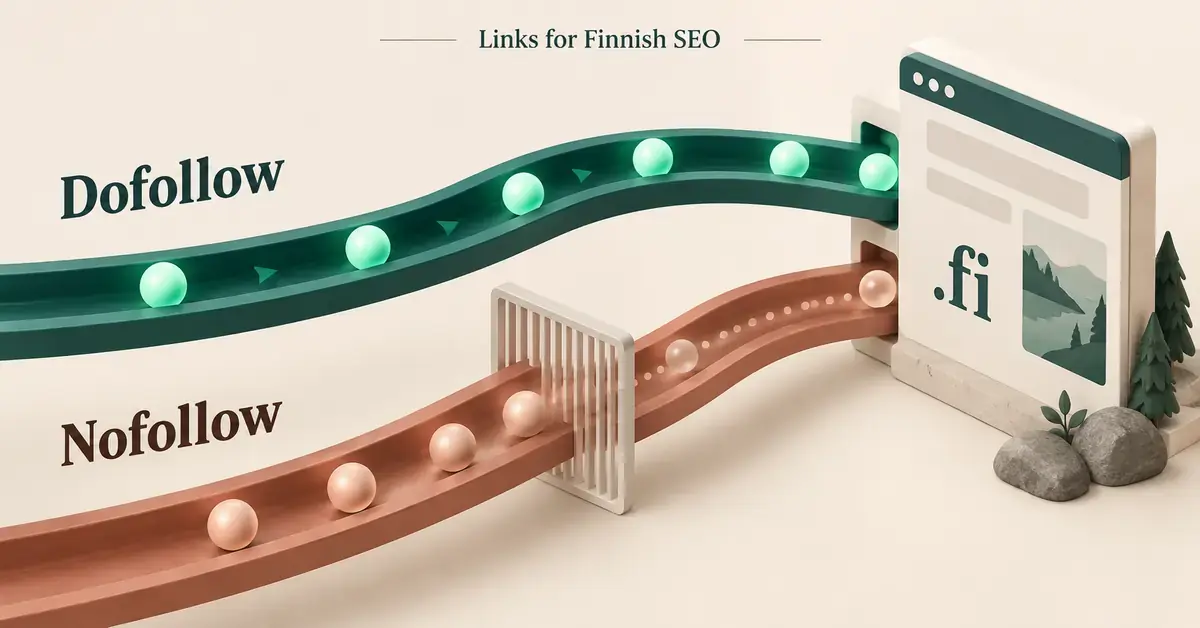
A nofollow link tells search engines not to pass ranking credit to the page it points to, while a dofollow (ordinary) link does pass that credit. Knowing the difference matters because a link profile made only of nofollow links rarely moves rankings, while the right mix of followed and attributed links builds trust safely. This guide explains what each link type does, how Google has treated them since 2020, and what all of this means if you are doing SEO for the Finnish market.
Key Takeaways
- A dofollow link is an ordinary link that passes ranking credit; a nofollow link asks Google not to pass that credit.
- There is no rel=”dofollow” attribute — links are followed by default.
- Google uses three restricting values: rel=”nofollow”, rel=”sponsored” (paid/affiliate) and rel=”ugc” (user content).
- Since 1 March 2020 these attributes are hints, not strict commands, for crawling, indexing and ranking.
- Nofollow links rarely move rankings but still bring traffic and keep a link profile natural.
- In Finland, paid links should use rel=”sponsored” and the commercial content must be disclosed to readers under consumer rules.
What are dofollow and nofollow links?
Every link on a web page is written in HTML as an anchor tag, for example <a href=”https://example.fi”>anchor text</a>. Search engines follow these links to discover pages and to decide how much authority one page passes to another. The rel attribute on that tag is what tells Google how to treat the link.
What is a dofollow link?
A dofollow link is a normal, editorial link that search engines are free to follow and count as a ranking signal. There is no special code involved: any link without a restricting rel value is “dofollow” by default. These are the links that can genuinely improve where a page ranks, because Google uses them to understand which pages other sites consider trustworthy and relevant.
What is a nofollow link?
A nofollow link carries the attribute rel=”nofollow”, which asks Google not to associate your site with the linked page and, in most cases, not to follow that link for ranking purposes. The attribute was introduced in 2005 to fight comment spam. Today you will find it applied automatically to links in blog comments, forum posts, many social media profiles, and most large reference sites.
Is “dofollow” a real HTML attribute?
No. This is the single most common misunderstanding about links. There is no rel=”dofollow” in HTML. “Dofollow” is just an informal word SEOs use for an ordinary followed link. You never add anything to make a link followed — you only add a rel value when you want to restrict how a link is treated. If an SEO tool reports a link as “dofollow,” it simply means the link has no nofollow, sponsored or ugc attribute.
The three link attributes Google uses today
Google now recognises three restricting values for the rel attribute, and it recommends choosing the one that best describes the link. Using the right value helps Google understand your site and keeps you clearly inside its guidelines.
rel=”nofollow”
Use this when you do not want to vouch for the linked page but none of the more specific values fit. Google describes it as the fallback option. A typical example is linking to a source you are quoting critically, where you do not want to pass an endorsement.
rel=”sponsored”
Use this for links that are paid for or part of any advertising or commercial arrangement, including affiliate links. Google introduced it in September 2019 and now prefers it over plain nofollow for paid placements. For anyone running affiliate or sponsored content aimed at Finnish readers, this is the correct attribute — and, as explained below, Finnish consumer rules also require the commercial nature of such content to be disclosed to the reader.
rel=”ugc”
UGC stands for user-generated content. Use this value for links inside content that your visitors create, such as comments and forum threads. Site owners may drop the attribute for trusted members who have consistently made high-quality contributions over time.
Can you combine link attributes?
Yes. Google allows more than one value in a single rel attribute, written as a space- or comma-separated list. For example, rel=”ugc nofollow” or rel=”ugc,nofollow” are both valid. This is useful when a link is both user-submitted and something you do not want to endorse.
Nofollow is now a “hint,” not a command
Since 1 March 2020, Google treats nofollow, sponsored and ugc as hints rather than strict directives. Before that date, nofollow was an absolute instruction: Google would not follow the link at all. Now Google says these attributes are used for crawling, indexing and ranking purposes, but it may still choose to follow a nofollowed link if its systems judge it useful.
In practice this means two things. First, a nofollowed link is no longer a guaranteed dead end — Google can learn from it. Second, you should not rely on nofollow to hide a page from Google. A nofollowed page may still be crawled if Google finds it through a sitemap or another site. To stop crawling, block the URL in robots.txt; to stop indexing, allow crawling and apply a noindex rule instead.
Do nofollow links affect SEO rankings?
Nofollow links usually pass little or no direct ranking credit, so they rarely move a page up the results on their own. That is the honest, evidence-based answer. However, they are far from worthless for three reasons:
- Traffic and visibility. A nofollow link from a popular Finnish news site or forum can send real visitors and raise brand awareness, regardless of ranking credit.
- A natural profile. Real websites accumulate a mix of followed and nofollowed links. A profile made almost entirely of followed, keyword-rich links looks manipulated and can trigger scrutiny.
- Discovery and context. Because nofollow is now only a hint, Google can still use these links to discover pages and understand relationships between sites.
The mistake is to assume the opposite — that followed links are always safe and valuable. A followed link from a spammy or paid network can do real harm. In Google’s December 2022 link spam update, its SpamBrain system was used to detect and neutralise unnatural links so that any credit they passed was simply ignored. This was not a manual penalty with a warning in Search Console; the links just stopped counting. The lesson is that the quality and honesty of a link matter far more than whether it is technically followed.
Nofollow vs dofollow: a side-by-side comparison
The table below summarises how the main link types differ and when each is appropriate.
Link Attribute Comparison
| Link type | rel value | When to use it | Passes ranking credit? |
|---|---|---|---|
| Followed (“dofollow”) | none | Genuine editorial links you are happy to endorse | Yes |
| Nofollow | rel=”nofollow” | Links you do not want to vouch for when no other value fits | Little or none (treated as a hint) |
| Sponsored | rel=”sponsored” | Paid, advertising or affiliate links | No (and must be disclosed in Finland) |
| User-generated | rel=”ugc” | Links inside comments, forums and other visitor content | Little or none |
What nofollow vs dofollow means for Finnish SEO
The mechanics of link attributes are the same everywhere, but a few things make them especially relevant for sites targeting Finland.
Google’s dominance in Finland makes its link guidelines decisive
Google handles roughly 84–87% of all searches in Finland, according to StatCounter, with Bing and Yandex sharing most of the remainder. Because almost all Finnish search traffic flows through Google, following Google’s link guidance is not optional — how Google interprets your links effectively decides your organic visibility in the Finnish market.
Paid and affiliate links must be disclosed under Finnish law
In Finland, any marketing must be clearly identifiable as marketing. The Finnish Competition and Consumer Authority (Kilpailu- ja kuluttajavirasto, KKV) adopted revised influencer-marketing guidelines on 31 January 2025, and the advertising company is always responsible for making sure a commercial collaboration is communicated to consumers. This connects directly to link attributes: if you place a paid or affiliate link in Finnish content, you should both label the content as commercial for readers and mark the link with rel=”sponsored” for Google. The disclosure obligation is a legal requirement, while the attribute is a Google guideline — serious publishers meet both at once.
Finnish directories, forums and news sites
Many of the most accessible link sources in Finland — business directories, Suomi24-style forums, and comment sections — apply nofollow or ugc automatically. That is normal and fine. These links still bring referral traffic and help build a natural profile. The higher-value followed links usually come from editorial placements: a genuine mention in a Finnish trade publication, a useful resource another site chooses to cite, or a well-earned guest contribution. Before chasing any link, it is worth learning how to evaluate Finnish websites so you spend effort where it counts.
How to build a healthy link profile in Finland
A strong Finnish link profile is earned, not forced. The goal is a believable mix of followed and nofollowed links from relevant, trustworthy Finnish sources. A few practical principles:
- Earn editorial links. Create content Finnish sites genuinely want to reference. Thoughtful link building outreach to Finnish websites is how most followed links are won.
- Keep anchor text natural. Over-optimised, exact-match anchors are a classic red flag. Vary your wording and favour brand and natural-language anchors, as covered in our guide to Finnish anchor text.
- Mark paid links correctly. Any link you paid for should use rel=”sponsored”. The rules around this are explained in detail in our overview of paid links and Google’s rules in Finland.
- Avoid link schemes. Private blog networks and bulk link packages are exactly what SpamBrain is built to catch. See why PBN links are not safe before buying into one.
Common mistakes with nofollow and dofollow links
Even experienced site owners get link attributes wrong. These are the errors we see most often:
- Chasing only followed links. A profile with no nofollow links looks unnatural. Real sites earn both.
- Thinking nofollow links are useless. They still drive traffic, support brand discovery, and keep your profile believable.
- Leaving paid links as plain followed links. An undisclosed paid followed link breaches Google’s guidelines and, in Finland, the duty to identify marketing. Use rel=”sponsored” and disclose it.
- Using nofollow to hide a page. Nofollow does not prevent crawling or indexing; use robots.txt or noindex for that.
- Buying “dofollow” link packages. There is no magic in a followed link from a low-quality network. These are the links most likely to be ignored or to cause harm. For a wider list, see the most common link building mistakes in Finland.
How to check whether a link is nofollow or dofollow
You can inspect any link yourself without special tools. Right-click the link in your browser and choose “Inspect” to view the HTML. Look at the anchor tag: if you see rel=”nofollow”, rel=”sponsored” or rel=”ugc”, the link is restricted; if there is no rel value (or only values like noopener), it is a followed link. Browser extensions such as link-highlighting tools, and SEO platforms like Ahrefs or Semrush, can colour-code an entire page or a full backlink profile automatically, which is faster when you are auditing many links at once.
Sources
- Google Search Central — Qualify your outbound links to Google
- Google Search Central — Evolving “nofollow”, new ways to identify the nature of links
- Google Search Central — December 2022 link spam update
- Search Engine Land — Google to treat nofollow as a “hint”
- StatCounter — Search engine market share in Finland
- Finnish Competition and Consumer Authority (KKV) — Influencer marketing guidelines
- Ahrefs — The state of nofollow, UGC & sponsored link attributes
Frequently Asked Questions (FAQ)
Is dofollow or nofollow better for SEO?
Neither is simply “better” — a healthy profile needs both. Followed links pass ranking credit and can lift your position, while nofollow links bring traffic, build brand awareness, and keep your profile looking natural. Relying on only one type is the real mistake.
Do nofollow links help you rank on Google?
Nofollow links pass little or no direct ranking credit, so they rarely move rankings on their own. They still help indirectly through referral traffic, brand visibility, and a more natural overall link profile, and since 2020 Google may treat them as hints rather than ignoring them completely.
What is the difference between nofollow, sponsored and ugc?
All three are restricting values for a link’s rel attribute. Use nofollow as a general fallback when you do not want to endorse a page, sponsored for paid or affiliate links, and ugc for links inside user-generated content such as comments and forum posts. You can also combine them, for example rel=”ugc nofollow”.
How do I make a link dofollow?
You do not need to do anything. A link is followed by default, and there is no rel=”dofollow” attribute in HTML. You only add a rel value — such as nofollow, sponsored or ugc — when you want to restrict how the link is treated.
Do paid links in Finland need the sponsored attribute?
Yes. Any link you pay for should carry rel=”sponsored” to stay inside Google’s guidelines. Separately, Finnish consumer rules require commercial content to be clearly identifiable as marketing, so you should also disclose the paid relationship to readers. Meeting both the attribute and the disclosure is the correct approach.
