
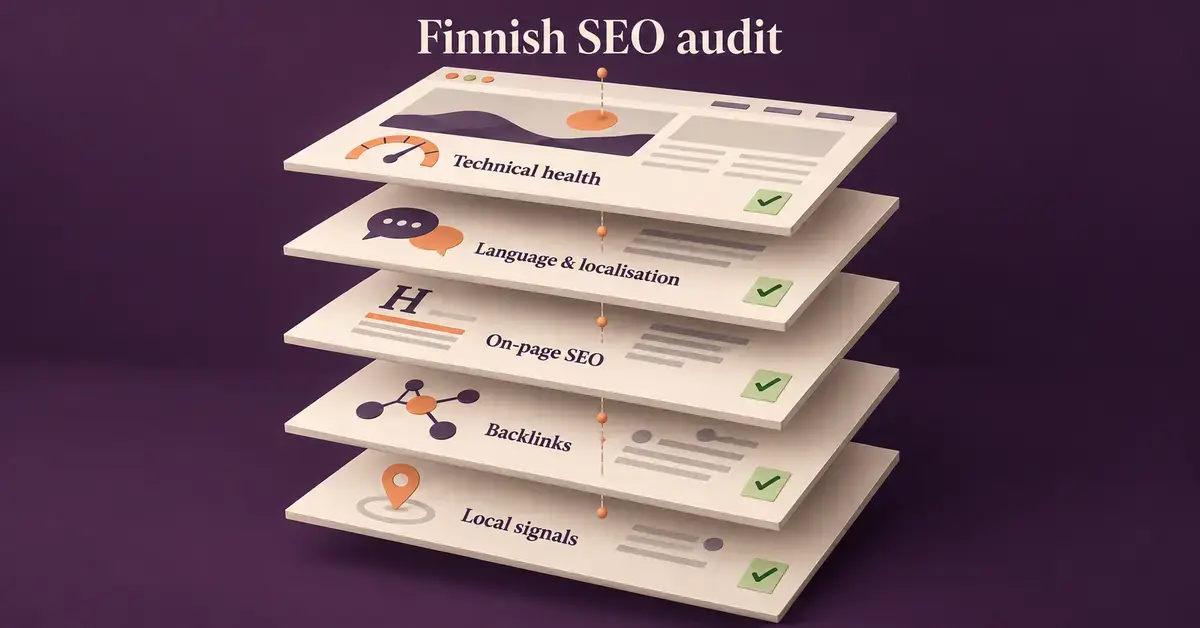
A Finnish SEO audit is a structured review of how well your website is set up to rank for searches made in Finland. It checks the same technical, content and link signals as any audit, but through a Finnish lens: the language your pages are written in, how Finnish users actually search, and the local signals Google uses to decide which results to show in Finland. This guide turns that review into a plain checklist you can work through section by section, with the reasoning behind each check so you know why it matters.
Key Takeaways
- A Finnish SEO audit reviews five layers: technical health, language and localisation, on-page SEO, backlinks and local signals.
- Since April 2025 Google has been retiring google.fi and other country domains; optimise for Finnish users and language, not a specific domain.
- Google handles about 84% of searches in Finland, so the audit is effectively a Google audit.
- Core Web Vitals targets: LCP 2.5s or faster, INP 200ms or less, CLS 0.1 or less, measured from real users.
- Finnish content should be genuinely localised, not machine-translated, because the language inflects words and builds compounds.
- For backlinks, relevant Finnish links matter more than sheer volume.
What is a Finnish SEO audit?
A Finnish SEO audit is a systematic check of the signals that influence whether your pages appear for searches made from Finland or in the Finnish language. It is diagnostic, not promotional: the goal is to find what is holding rankings back and list the fixes in priority order.
Most audits cover five layers: technical health (can Google crawl and render the site), language and localisation (is the content genuinely Finnish), on-page optimisation (do pages match search intent), off-page authority (do credible Finnish sites link to you), and local signals (does Google connect you to a Finnish location). A thorough audit produces a list of issues grouped by impact, not a single score.
Does ranking on google.fi still matter after Google’s domain change?
Ranking in Finland still matters, but the specific address google.fi no longer does. In April 2025 Google announced it was retiring its country-code domains and redirecting them to google.com, because the results you see are already localised by your location and settings rather than by the domain you visit. A searcher in Helsinki who types a query into google.com sees the same Finnish-focused results they used to get on google.fi.
The practical takeaway for your audit: stop thinking of “ranking on google.fi” as a separate technical target and think of it as ranking for users located in Finland and searching in Finnish. Location, language and relevance signals drive that, not the domain in the address bar. Everything in the checklist below is aimed at those signals.
How dominant is Google in Finland?
Google handles roughly 84% of searches in Finland, according to Statcounter, with Bing and Yandex each sitting in the region of 5-6%. Because Google is so dominant, a Finnish SEO audit is effectively a Google audit. Bing is worth a quick sanity check (make sure it can crawl the site), but your priorities should follow Google’s documented best practices.
Technical SEO audit checklist
Technical SEO is the foundation: if Google cannot crawl, render and index your pages efficiently, nothing else in the audit will help. Work through these checks first.
Crawlability and indexing
- robots.txt — confirm it does not accidentally block important pages or your sitemap.
- XML sitemap — present, submitted in Google Search Console, and listing only canonical, indexable URLs.
- Index coverage — check the Pages report in Search Console for pages excluded by “noindex”, redirects or “crawled, not indexed” errors.
- Canonical tags — each page points to a single preferred URL, so Finnish and duplicate variants do not compete with each other.
- Redirects — old URLs use clean 301 redirects; avoid long redirect chains and broken links.
Core Web Vitals and page speed
Core Web Vitals are Google’s page-experience metrics, measured from real users at the 75th percentile (meaning at least 75% of visits must hit the “good” bar). Audit all three:
- Largest Contentful Paint (LCP) — loading speed; good is 2.5 seconds or faster.
- Interaction to Next Paint (INP) — responsiveness to clicks and taps; good is 200 milliseconds or less. INP replaced First Input Delay (FID) as a Core Web Vital in March 2024, so any audit template still referencing FID is out of date.
- Cumulative Layout Shift (CLS) — visual stability as the page loads; good is 0.1 or less.
Check the field-data report in Search Console or PageSpeed Insights, and test on mobile first, since most Finnish traffic is mobile.
Mobile, HTTPS and structured data
- Mobile usability — Google indexes the mobile version of your site, so the mobile layout must contain the same content and links as desktop.
- HTTPS — the whole site should load over a valid certificate with no mixed-content warnings.
- Structured data — add relevant schema.org markup (Organization, Article, Product, LocalBusiness, FAQ) so Google can display rich results; validate it with Google’s Rich Results Test.
Language and localisation audit checklist
Language is where a Finnish audit differs most from a generic one. Google rewards content that reads as if it were written for Finnish speakers, not run through a translation tool.
Is your content written for Finnish, not just translated?
Finnish is a morphologically rich language with around fifteen grammatical cases, heavy use of compound words, and vowel harmony that changes word endings. A phrase translated word-for-word from English often reads unnaturally and misses the forms people actually type. Audit whether native speakers wrote or at least reviewed the content, and whether it uses natural Finnish phrasing rather than literal translation. For the difference between the two approaches, see our guide on translation versus localisation for Finnish.
Is your keyword research based on how Finns search?
Because Finnish inflects nouns and builds long compounds, a single concept can be searched in many surface forms, and the most-used form is often not the dictionary form. Your audit should confirm that target keywords come from real Finnish search data rather than translated English terms. Our walkthrough on Finnish keyword research covers the tools and method; check that each priority page maps to a genuine Finnish query with search volume behind it.
Is language targeting set up correctly?
- HTML lang attribute — Finnish pages declare lang=”fi”.
- hreflang — if you run both Finnish and English versions, hreflang tells Google which to show to whom. Mistakes here are common and can suppress the wrong language in results; our guide to hreflang for Finnish and English websites covers the correct setup.
- Domain and hosting — a .fi domain is a helpful Finnish signal but not a requirement; audit whether your domain and server choice support, rather than hurt, local relevance (see .fi domain SEO).
On-page SEO audit checklist
On-page SEO is about matching each page to what the searcher wants. For every priority page, check:
- Search intent — the page format matches the query type (informational, commercial or transactional).
- Title tag — contains the main Finnish keyword near the front and stays within roughly 60 characters.
- Meta description — accurate, compelling, and under about 160 characters.
- Headings — one clear H1, logical H2/H3 structure, keywords used naturally.
- Internal links — related Finnish pages link to each other with descriptive anchor text.
- Images — compressed, with descriptive Finnish alt text.
- Content depth — the page answers the question more completely than the results currently ranking above it.
Off-page audit: backlinks and authority
Backlinks remain one of Google’s strongest ranking signals, and for the Finnish market relevance beats raw volume. A handful of links from established Finnish sites usually outweighs many links from unrelated foreign domains. Audit your link profile for:
- Relevance — are the linking sites Finnish or topically related to your niche?
- Quality — real editorial sites versus spammy or paid networks. For a vetting method, see how to evaluate Finnish websites before pursuing a link.
- Anchor text — a natural mix, not over-optimised exact-match Finnish keywords.
- Toxic links — identify obviously manipulative links that could carry risk.
- Gaps — which Finnish sites link to competitors but not to you?
When you move from auditing to earning links, prioritise relevant Finnish publishers and sustainable tactics such as outreach and digital PR over bought links.
Local SEO audit checklist
If you serve customers at a physical location or a specific Finnish city, local signals decide whether you appear in the map pack and “near me” searches. Check that:
- Your Google Business Profile is claimed, verified and complete, with correct Finnish opening hours and categories.
- Your name, address and phone number (NAP) are identical across your site and every directory listing.
- You have consistent citations in the main Finnish business directories.
- You are collecting and responding to reviews.
Our full guide to local SEO in Finland covers the profile, Maps and citation steps in detail.
Content and E-E-A-T audit checklist
Google favours content that shows experience, expertise, authoritativeness and trustworthiness (E-E-A-T). This matters most for pages that affect money or wellbeing, but it helps every site. Audit whether your pages:
- Name a real author with relevant credentials.
- Cite primary or official sources where facts, figures or dates are stated.
- Show clear contact details, an about page and transparent business information.
- Are kept up to date, with outdated figures and dead links removed.
- Serve the reader first, rather than reading like thin, keyword-stuffed filler.
Common Finnish SEO audit mistakes
Even careful audits go wrong in predictable ways. Watch for these:
- Still chasing google.fi as a target — since the April 2025 domain change, optimise for Finnish users and language, not a specific Google domain.
- Treating translation as localisation — machine-translated pages rarely use the Finnish word forms people actually search for.
- Auditing English keywords — pulling keyword ideas in English and translating them, instead of researching real Finnish queries.
- Broken or missing hreflang — bilingual sites that send the wrong language version into results.
- Volume over relevance in links — counting total backlinks instead of weighting Finnish, topically relevant ones.
- Desktop-only testing — checking speed and layout on desktop when Google indexes mobile first.
- Chasing a single score — trusting a tool’s one-number “SEO score” instead of a prioritised list of real issues.
How to run the audit, step by step
Work from the foundation upward so you fix blockers before fine-tuning. A practical order is:
- Confirm Google can crawl and index the site (technical layer).
- Fix Core Web Vitals and mobile issues flagged in Search Console.
- Review language targeting, hreflang and whether content is genuinely Finnish.
- Re-check keyword-to-page mapping against real Finnish search data.
- Optimise on-page elements on your priority pages.
- Audit the backlink profile and plan relevant Finnish link building.
- Verify local signals if you serve a physical area.
- Record every issue with its impact and effort, then fix highest-impact first.
If you would rather have the language, localisation and link-building parts handled for you, you can reach our team at [email protected].
Finnish SEO Audit Checklist
| Area | What to check |
|---|---|
| Technical | Crawlability, XML sitemap, index coverage, canonicals, clean 301 redirects, HTTPS |
| Core Web Vitals | LCP ≤ 2.5s, INP ≤ 200ms, CLS ≤ 0.1 (mobile field data) |
| Language | Native Finnish content, lang=”fi”, correct hreflang, Finnish keyword mapping |
| On-page | Intent match, title tag, meta description, heading structure, internal links, alt text |
| Off-page | Relevant Finnish backlinks, natural anchors, toxic-link and gap review |
| Local | Verified Google Business Profile, consistent NAP, Finnish directory citations, reviews |
| Content / E-E-A-T | Named author, cited sources, up-to-date facts, clear contact and about pages |
Sources
Frequently Asked Questions (FAQ)
What is a Finnish SEO audit?
It is a structured review of how well a website is set up to rank for searches made in Finland and in the Finnish language. It checks technical health, language and localisation, on-page optimisation, backlinks and local signals, then lists the fixes in priority order.
Do I still need to optimise for google.fi?
Not as a separate target. In April 2025 Google began retiring country-code domains such as google.fi and redirecting them to google.com, because results are already localised by the user’s location and settings. Optimise for people searching from Finland and in Finnish, rather than for a specific domain.
How often should I audit a Finnish website?
A full audit once or twice a year suits most sites, with a lighter monthly check of Search Console for new crawl errors, manual actions or Core Web Vitals drops. Run an extra audit after a site redesign, migration or a major Google update.
Is translated content enough to rank in Finland?
Usually not. Finnish uses compound words, around fifteen grammatical cases and vowel harmony, so literal translations often miss the forms people actually search. Content written or reviewed by a native speaker, based on real Finnish keyword data, performs far better.
Can I audit a Finnish site with standard SEO tools?
Yes. Google Search Console, PageSpeed Insights and the main crawling and backlink tools all work for Finnish sites. The difference is in interpretation: you still need Finnish-language judgement for keyword research, content quality and link relevance.
