
Finland and Sweden look almost interchangeable from the outside: two wealthy, digital, Google-dominated Nordic neighbours. For search engine optimisation (SEO) — the work of getting a website to rank higher in search results — they are not interchangeable at all. Sweden is roughly twice the size, more crowded with agencies, and written in a Germanic language. Finland is smaller, less contested in English-language niches, and written in Finnish, a language whose grammar bends keywords in ways that catch out newcomers. This guide compares the two markets on the three things that actually change your strategy and budget: market size, competition, and language.
Key Points
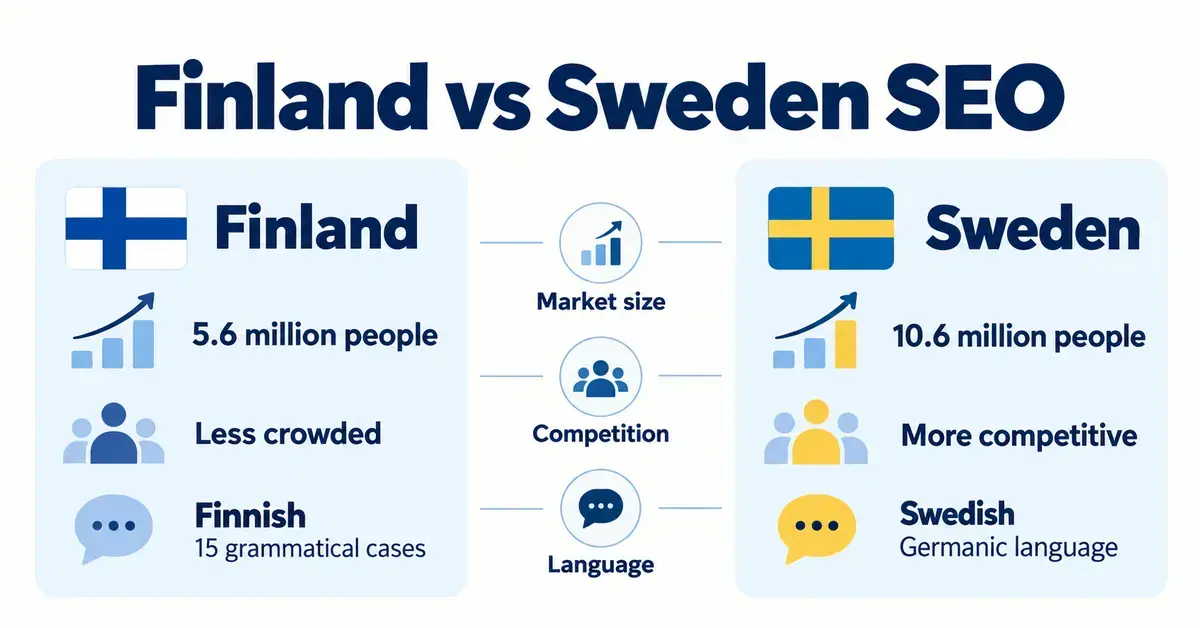
- Size: Sweden is about twice Finland’s size — roughly 10.6 million people and a larger economy versus Finland’s 5.6 million.
- Competition: Finland’s search market is generally less crowded; the Finnish language keeps many international rivals out.
- Language: Finnish is agglutinative with 15 grammatical cases; Swedish is Germanic and closer to English — they are unrelated and do not translate across.
- Search engine: Google dominates both markets (around 85–90% of searches), so the technical fundamentals are the same.
- Strategy: Treat Finland and Sweden as two markets with separate content, keywords and local links — not one “Nordic” project.
Two Nordic markets, two different opportunities
The core difference is scale versus access. Sweden is the larger prize but the busier room; Finland is the smaller room but often the easier one to be heard in, especially if you can produce genuinely Finnish-language content. Treating them as one “Nordic” project — one keyword list, one set of links, one translated site — is the most common and most expensive mistake, because the language barrier between them is real: Swedish and Finnish are not related languages, and content that works in one does not transfer to the other by translation alone.
If you are building or buying links across the region, it helps to plan at the country level rather than the regional level. Our overview of Nordic link building explains why each market needs its own domains, its own outreach and its own anchor strategy.
How big are the Finnish and Swedish markets?
Sweden is close to twice Finland’s size on almost every metric that matters for SEO. That single fact shapes everything downstream — traffic ceilings, revenue potential and how many competitors are chasing the same keywords.
Population and economy
Finland has about 5.6 million people and a nominal gross domestic product (GDP — the total value of goods and services a country produces) of roughly USD 335 billion. Sweden has about 10.6 million people and is the largest Nordic economy, with a GDP of around USD 610 billion in 2024. Put simply, Sweden offers about double the addressable audience and roughly double the economic activity, so the raw traffic and sales ceiling for a Swedish site is materially higher.
Online shopping and ecommerce
Both countries are among the most connected in the world. Internet penetration reached about 98.2% in Finland and about 98.3% in Sweden in early 2025, so “getting online” is not the constraint — being found is. Ecommerce is larger in Sweden in absolute terms: independent estimates put Swedish online-retail revenue several times higher than Finland’s, reflecting the bigger population and a slightly earlier, deeper ecommerce culture. Exact market-size figures vary widely between research firms depending on what they count, so treat any single number with caution and focus on the direction: Sweden bigger, Finland smaller but still highly digital.
For online retailers weighing where to invest first, the practical reading is that Sweden has more revenue to win and more rivals fighting for it, while Finland can deliver a strong return on a smaller, better-targeted effort. Our guide to ecommerce SEO in Finland goes deeper on the Finnish side of that decision.
Comparison
| Factor | Finland | Sweden |
|---|---|---|
| Population | ~5.6 million | ~10.6 million |
| GDP (nominal) | ~USD 335 billion | ~USD 610 billion (largest Nordic economy) |
| Internet penetration (early 2025) | ~98.2% | ~98.3% |
| Ecommerce size | Smaller in absolute terms | Larger; higher online-retail revenue |
| Main language | Finnish (Uralic, agglutinative, 15 cases) | Swedish (Germanic, Indo-European) |
| Official languages | Finnish and Swedish (bilingual) | Swedish |
| Currency | Euro (€) | Swedish krona (kr) |
| Dominant search engine | Google (~85–90%) | Google (~85–90%) |
| SEO competition | Lighter; language acts as a barrier | Heavier; more agencies and higher link costs |
How competitive is SEO in Finland vs Sweden?
Finland is generally the less crowded search market, and that is its main advantage. A larger market like Sweden attracts more agencies, more in-house teams and more content, which pushes up the cost and effort needed to rank for commercial terms. Sweden’s digital-marketing sector is bigger and more mature, so competition for high-value keywords — finance, insurance, travel, igaming — tends to be fiercer and link prices higher.
Finland’s competition is lighter for two reasons. First, the smaller market simply supports fewer competitors. Second, and more importantly, the Finnish language acts as a natural barrier: many international brands never produce proper Finnish content, so a site that does can outrank far bigger players on Finnish keywords. That barrier is weaker in Sweden, where Swedish is easier for outsiders to translate into passable copy and where more foreign competitors are willing to invest.
None of this means Finland is “easy”. Local publishers, established Finnish brands and a tight-knit media landscape mean quality still wins. It does mean the effort-to-reward ratio is often more favourable in Finland for businesses that commit to authentic local content and links. If you are deciding between doing this yourself or hiring help, our comparison of SEO in Finland lays out what a realistic local campaign involves.
How do the languages change your SEO?
Language is the single biggest technical difference between the two markets, because Finnish and Swedish are not related and behave very differently in search. Swedish is a Germanic, Indo-European language — a cousin of English, Danish and Norwegian. Finnish is a Uralic (Finno-Ugric) language with no close relatives among its neighbours. Keyword research, on-page optimisation and anchor text all have to respect those differences.
Finnish stacks meaning onto words
Finnish is agglutinative, meaning it builds words by adding a chain of suffixes to a root, each suffix adding a piece of grammar. It has 15 grammatical cases, so a single noun can appear in dozens of surface forms depending on its role in the sentence. “In Helsinki”, “from Helsinki” and “to Helsinki” are all one word in Finnish with different endings, not a word plus a preposition. Finnish also uses consonant gradation (letters inside a word change as endings are added) and heavy compounding (several concepts fused into one long word).
For SEO this matters because your exact keyword rarely appears in its dictionary form in real sentences. Search engines handle Finnish morphology reasonably well, but keyword research tools often undercount volume because they treat each inflected form as a separate term. The practical response is to research the natural inflected forms Finns actually type and to write content that reads naturally rather than forcing a stiff base-form keyword. Anchor text needs the same care — our guide to Finnish anchor text covers how to vary inflected forms without looking manipulative.
Swedish behaves more like English
Swedish is far closer to English in structure. It has two grammatical genders (called en and ett words), a definite article that attaches to the end of a noun (“a house” is ett hus, “the house” is huset), and much simpler inflection than Finnish. Compounding exists in Swedish too, but the overall system is easier for translation tools and non-native marketers to handle. That accessibility is a double edge: it makes Swedish content cheaper to produce, which is exactly why Swedish keywords are more contested.
Finland is officially bilingual
Finland has two official languages: Finnish and Swedish. About 5% of Finns — roughly 290,000 people — speak Swedish as their first language, and some regions, notably the Åland Islands and parts of the coast, are majority Swedish-speaking. For most national campaigns Finnish is the priority, but Swedish-language Finnish content can be a genuine niche opportunity, and it is a different job from targeting Sweden itself — the audience, media and search intent are Finnish, only the language is Swedish. Deciding how far to adapt content, rather than just translate it, is central here; see translation versus localisation for where the line sits.
What about search engines and user behaviour?
Google dominates both countries, so you are optimising for the same engine either way. Google’s share sits at roughly 85–90% of searches in both Finland and Sweden, with Bing a distant second and shares even higher on mobile. That means the fundamentals — relevant content, a technically sound site, and authoritative backlinks (links from other sites that act as votes of trust) — apply equally in both markets.
User behaviour is broadly similar too: both populations are highly digital, mobile-first and comfortable shopping online, and both value clear, trustworthy, no-nonsense content over hard selling. The differences that matter are cultural nuance and language, not platform. A Swedish audience and a Finnish audience expect content in their own language, referencing local context, prices in euros (Finland uses the euro; Sweden uses the krona), and local delivery and payment norms.
Which market should you prioritise?
Choose based on where your product fits and how much competition you can absorb, not on which country is bigger. A few honest rules of thumb:
- Go Sweden-first if you need volume, sell in a category with strong Swedish demand, and have the budget to fight established competitors and higher link costs.
- Go Finland-first if you want a more defensible position, can invest in authentic Finnish content, and prefer a better effort-to-reward ratio in a lighter market.
- Do both, but separately if you are serious about the Nordics — with distinct sites or sections, distinct keyword research, and distinct local links per country.
Whatever you choose, the localisation and link building must be genuinely local. If you want help planning a Finnish campaign or a two-country Nordic rollout, you can reach the team at [email protected].
Common mistakes when expanding between Finland and Sweden
The costliest errors come from treating the two markets as one. Watch for these:
- Translating Swedish content straight into Finnish (or vice versa). The languages are unrelated; direct translation produces awkward, low-ranking copy. Content needs to be localised — rewritten for local search intent — not just translated.
- Ignoring Finnish inflection in keyword research. Targeting only the dictionary form of a keyword misses the inflected forms real users type, and can make search volume look smaller than it is.
- Using one set of backlinks for the whole region. Swedish links do little for a Finnish site’s authority in Finnish results, and mixing signals dilutes both. Build country-specific links from country-specific sites.
- Assuming Finland is empty. Lower competition is not no competition; local incumbents and publishers are strong, and quality still decides.
- Confusing Swedish-speaking Finland with Sweden. They share a language but not an audience, media or market — targeting one does not cover the other.
- Copying pricing and payment cues. Finland uses the euro and Sweden the krona, with different delivery and payment habits; details that feel local build trust and conversions.
Sources
- DataReportal — Digital 2025: Finland (internet penetration, users)
- DataReportal — Digital 2025: Sweden (internet penetration, users)
- StatCounter — Search Engine Market Share, Finland
- StatCounter — Search Engine Market Share, Sweden
- Statista — E-commerce in Finland (statistics & facts)
- IBISWorld — E-Commerce in Sweden, Industry Analysis
- International Trade Administration — Sweden Market Overview (economy, GDP)
- International Trade Administration — Finland Market Overview
- Minority Rights Group — Swedish Speakers in Finland
- OpenL — Finnish: cases, agglutination and grammar overview
Frequently Asked Questions (FAQ)
Is SEO easier in Finland or Sweden?
Finland is usually the less competitive market because it is smaller and because the Finnish language deters many international competitors from producing proper local content. Sweden offers more traffic and revenue but with more agencies and higher link costs. “Easier” depends on your budget and how well you can produce authentic local content, but Finland often gives a better effort-to-reward ratio.
Do I need separate websites for Finland and Sweden?
You need separate content and separate local links at minimum, because the languages and audiences are different. Many businesses use distinct country sites or clearly separated language sections, each with its own keyword research and its own local backlinks. Sharing one translated site and one link set across both markets tends to underperform in both.
Can I just translate my content between Finnish and Swedish?
No. Finnish and Swedish are unrelated languages, and direct translation produces stiff, poorly ranking copy that misses local search intent. Content should be localised — rewritten to match how people in each country actually search and buy — rather than translated word for word.
Which search engine should I optimise for in Finland and Sweden?
Google, in both countries. Google holds roughly 85–90% of searches in Finland and Sweden and even more on mobile, with Bing a distant second. The technical fundamentals — relevant content, a sound site and quality backlinks — are the same for both markets because you are optimising for the same engine.
Does Finland’s official bilingualism affect my SEO?
It can. About 5% of Finns speak Swedish as their first language, and some coastal regions and the Åland Islands are majority Swedish-speaking. Swedish-language content aimed at Finland is a genuine niche, but it is a Finnish audience with Finnish context that happens to read Swedish — not the same as targeting Sweden, and it should be planned separately.
