
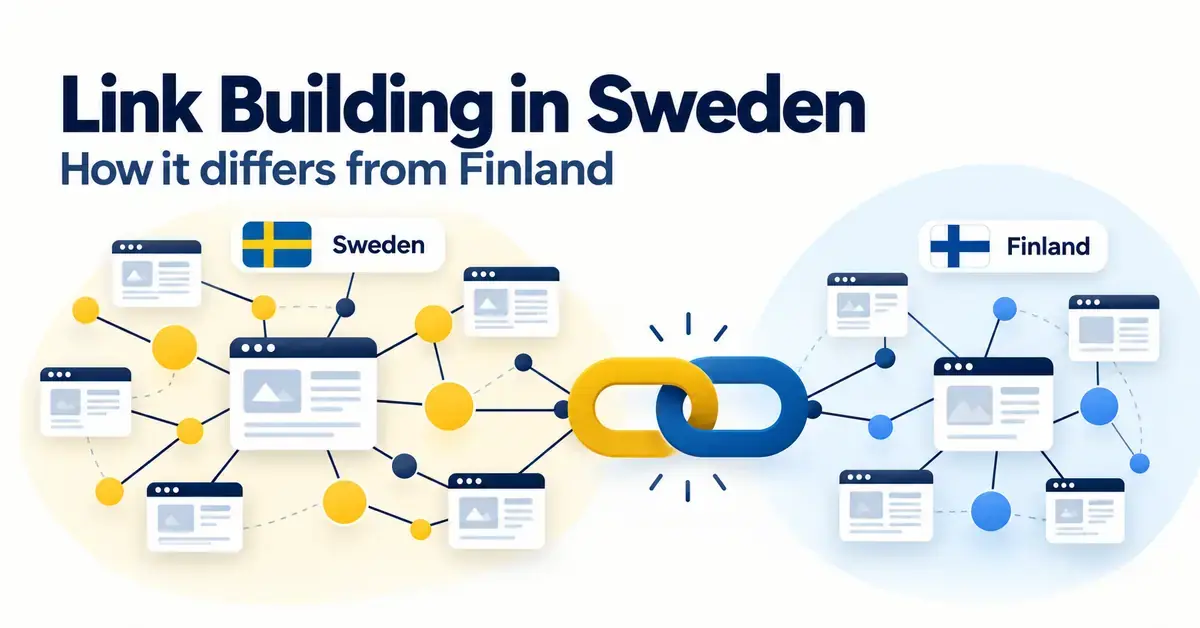
Sweden and Finland sit side by side on the map and are often treated as a single Nordic marketing region, yet the two countries reward noticeably different link building strategies. Sweden is a larger, more competitive market with its own language, its own directory ecosystem and a licensed gambling system that Finland is only now moving towards. This guide explains how link building in Sweden works and, just as importantly, where it diverges from the Finnish approach that most of this site covers.
Key Points
- Bigger market: Sweden has about 10.6 million people versus roughly 5.6 million in Finland — more linking sites, but more competition.
- Easier language: Swedish inflects far less than Finnish, so keyword anchors and content are simpler to produce.
- Different directories: Sweden relies on hitta.se, eniro.se, ratsit.se and reco.se rather than the Finnish equivalents.
- Gambling is regulated differently: Sweden has been a licensed market under Spelinspektionen since 2019; Finland opens its licensed market on 1 July 2027.
- Same search engine: Google dominates both markets (~86% in Sweden), so the ranking goals carry over.
- Budget higher: Swedish placements typically cost more than Finnish ones because of greater competition.
What is link building, and why does Sweden need its own playbook?
Link building is the practice of earning links from other websites to your own so that search engines treat your pages as more trustworthy and rank them higher. The mechanics — outreach, guest posts, digital PR, directories and content that naturally attracts citations — are the same everywhere. What changes from country to country is the supply of good linking sites, the language of the anchor text, the regulations that limit certain industries and the level of competition for each placement.
Sweden needs its own playbook because it is a bigger and more mature market than Finland. There are more Swedish-language publishers, more agencies chasing the same links and a deeper pool of directories and niche blogs. A campaign copied straight from a Finnish plan will usually under-price the competition, miss the strongest Swedish placements and, in regulated niches such as gambling, apply the wrong rules entirely.
How big is the Swedish market compared with Finland?
Sweden is roughly twice the size of Finland by population. Sweden had about 10.6 million residents in mid-2026 according to Statistics Sweden, while Finland sits at around 5.6 million. That difference shapes everything downstream: more people means more Swedish-language websites, more news outlets, more online shops and therefore more potential linking domains — but also more brands and agencies competing for the best ones.
The practical consequences for link building are:
- More inventory, more competition. You will find far more Swedish blogs and media titles willing to publish than in Finland, but the strongest placements are contested and priced accordingly.
- Higher baseline volume. Because the market is bigger, ranking for competitive Swedish keywords typically requires more referring domains than the Finnish equivalent.
- Scarcity works differently. In Finland, a handful of quality sites in a niche can dominate; in Sweden the field is wider, so relevance and topical fit matter more than simply securing a rare link.
Google is the dominant search engine in both countries, so the ranking signals you are optimising for are the same. As of August 2026, Google held roughly 86% of the Swedish search market, with Bing a distant second — a picture that mirrors Finland closely. If you already understand the fundamentals from our guide to SEO in Finland, the technical goals carry over; only the execution changes.
Does language change how you build links in Sweden?
Yes — language is one of the biggest practical differences. Sweden is overwhelmingly Swedish-speaking, and Swedish is a North Germanic language that is far easier for many international teams to work with than Finnish. Finnish is a Finno-Ugric language with complex grammar and word structure, which makes Finnish content harder to produce, localise and proofread. In Sweden you will find a larger supply of writers, and English-speaking outreach teams generally find Swedish sites easier to communicate with.
That said, links still need Swedish-language, natively written content around them. Machine-translated guest posts read poorly to Swedish editors and are routinely rejected, exactly as they are in Finland. The lesson from content localisation applies on both sides of the Gulf of Bothnia: hire native writers, localise rather than translate, and match the tone of the target publication.
Which Swedish websites and directories are worth a link?
The best Swedish links come from three broad sources: news and digital PR, business directories and local citations, and topical guest posts. Each behaves slightly differently from its Finnish counterpart.
News and digital PR
Sweden has a strong national and regional press. The largest titles include the tabloids Aftonbladet and Expressen and the broadsheets Dagens Nyheter and Svenska Dagbladet, several of which sit under large publishing groups. A newsworthy data study, survey or expert comment can earn coverage — and links — from these outlets, which is the essence of digital PR. The tactics are identical to those in our digital PR guide; the difference is that Sweden offers a wider pool of national outlets to pitch, and the competition for journalists’ attention is fiercer.
Business directories and local citations
Local SEO in Sweden leans on a distinct set of directories. The main names are hitta.se and eniro.se — the two largest Swedish search-and-directory portals — along with ratsit.se and the review site reco.se. These are the Swedish equivalents of the Finnish directories: the platforms differ, but the principle is the same. Keep your business name, address and phone number (known as NAP) consistent across every listing so the citations reinforce each other rather than confusing search engines.
Guest posts and niche blogs
Guest posting on relevant Swedish blogs remains a workhorse tactic. Because the market is larger, you will find more candidate sites than in Finland, but you also need to filter harder for genuine editorial standards rather than low-quality link farms. The evaluation criteria from our guest posting playbook — real traffic, topical relevance, editorial oversight and a clean link profile — transfer directly to Sweden.
How does Swedish anchor text differ from Finnish?
Anchor text is the visible, clickable words in a link, and it should read naturally in the target language. In Swedish this is more forgiving than in Finnish. Finnish grammar changes the endings of words depending on their role in a sentence, so a keyword rarely appears in its plain “dictionary” form, and forcing an exact-match anchor often produces awkward or unnatural phrasing. Swedish inflects far less, so keyword-style anchors sit more comfortably inside a sentence.
The safe strategy is still the same in both countries: keep anchor text varied and natural, lean on branded and generic anchors, and avoid stuffing the exact keyword into every link. Our detailed notes on Finnish anchor text explain why over-optimisation is risky; the principle holds for Sweden, even though the grammatical friction is lower.
What about link building for iGaming and gambling in Sweden?
This is where Sweden and Finland diverge most sharply. Sweden re-regulated its gambling market on 1 January 2019, replacing the old state monopoly with a licensing system supervised by Spelinspektionen (the Swedish Gambling Authority) under the Gambling Act (2018:1138). That means Sweden has had a mature, licensed affiliate and iGaming ecosystem for several years, with an established set of operators, publishers and marketing rules.
Finland is only now catching up. The Veikkaus online monopoly is being dismantled: licence applications open on 1 March 2026 and the licensed market is scheduled to open on 1 July 2027, with Veikkaus keeping a monopoly on lotteries and certain land-based games. Until then, the Finnish iGaming link building landscape works under very different constraints, as covered in our guide to Finnish gambling affiliate rules.
For Swedish gambling link building specifically, a few rules matter more than link volume:
- Only promote licensed operators. Affiliates must ensure their partners hold a Swedish licence; aiding unlicensed operators aimed at the Swedish market is prohibited.
- Marketing is tightly controlled. Sweden’s Consumer Agency introduced stricter marketing guidelines that took effect on 1 September 2025, and marketing must not target people who have self-excluded.
- Enforcement is active. Spelinspektionen has publicly flagged affiliates and influencers promoting unlicensed gambling as an enforcement priority.
None of the above should be read as advice to gamble or as a promise that any marketing tactic improves outcomes for players; see the disclaimer below for responsible-gambling resources.
Sweden vs Finland: the key differences at a glance
The table below summarises how the two markets compare on the factors that most affect a link building campaign.
Sweden vs Finland at a Glance
| Factor | Sweden | Finland |
|---|---|---|
| Population (approx.) | ~10.6 million | ~5.6 million |
| Primary language | Swedish (low inflection) | Finnish (highly inflected) + Swedish minority |
| Dominant search engine | Google (~86%) | Google (dominant) |
| ccTLD & registry | .se — Internetstiftelsen | .fi — Traficom |
| Main directories | hitta.se, eniro.se, ratsit.se, reco.se | Finnish directories (e.g. fonecta.fi) |
| Leading news for digital PR | Aftonbladet, Expressen, Dagens Nyheter, Svenska Dagbladet | Helsingin Sanomat, Iltalehti, Ilta-Sanomat |
| Gambling model | Licensed since 1 Jan 2019 (Spelinspektionen) | Veikkaus monopoly; licensed market opens 1 Jul 2027 |
| Link supply vs competition | Larger supply, more competition | Smaller supply, scarcer but less crowded |
| Typical link cost | Higher per placement | Generally lower |
How much does link building in Sweden cost?
Swedish link building usually costs more per placement than the Finnish equivalent, for two reasons: the market is larger and more competitive, and there are more advertisers bidding for the same quality sites. Prices vary widely by link type — a niche guest post costs far less than earned coverage in a national newspaper — so treat any single figure with caution and judge each opportunity on the quality of the linking domain rather than a flat rate.
Rather than chasing the lowest price, weigh each prospective link on real traffic, topical relevance and editorial quality, using the same checklist you would apply when you evaluate Finnish websites. A slightly more expensive, genuinely relevant Swedish link almost always outperforms a cheap link from a low-quality network.
Common mistakes when building links in Sweden
Teams that succeed in Finland sometimes stumble in Sweden by assuming the two markets are interchangeable. The most frequent mistakes are:
- Reusing the Finnish gambling playbook. Applying Finland’s pre-2027 monopoly logic to Sweden’s licensed market — or vice versa — leads to compliance errors and wasted outreach.
- Under-budgeting. Pricing a Swedish campaign at Finnish rates leaves you unable to secure the stronger, more contested placements.
- Publishing translated content. Running Finnish or English copy through machine translation gets guest posts rejected by Swedish editors and reads poorly to users.
- Ignoring Swedish directories. Skipping hitta.se, eniro.se and other local citations leaves easy, credible links on the table.
- Over-optimised anchors. Swedish grammar tolerates keyword anchors better than Finnish, which tempts teams to overuse exact-match text and trip spam filters.
Many of these echo the wider Nordic link building pitfalls that apply across the region — the details change per country, but the underlying discipline does not.
Who should invest in Swedish link building?
Swedish link building suits any business that ranks, or wants to rank, in Google for Swedish-language searches: e-commerce shops selling to Sweden, SaaS and B2B companies expanding across the Nordics, and licensed iGaming operators and their affiliates. If you already run campaigns in Finland and are moving into Sweden, the smartest approach is to keep your quality standards constant while re-tuning language, budget, directories and — above all — the regulatory rules for your niche.
If you are planning a cross-border Nordic push, it usually pays to run Sweden and Finland as related but separate campaigns rather than one blended effort. You can talk through a country-specific plan on our contact page.
Disclaimer
This article is informational and covers gambling only in the context of digital marketing and link building. It is not gambling advice, and nothing here suggests that any marketing tactic improves a player’s chances of winning. Gambling in Sweden is restricted to adults aged 18 and over. Players who want to limit or pause their gambling can register with the national self-exclusion service Spelpaus, seek free confidential support from Stödlinjen, or check operator licences with Spelinspektionen.
Sources
- Statistics Sweden (SCB) — Population statistics
- StatCounter — Search Engine Market Share Sweden
- Spelinspektionen (Swedish Gambling Authority)
- Finnish Government — Gambling system reform (licensing)
- Finnish Ministry of the Interior — Gambling reform Q&A
- The Swedish Internet Foundation (Internetstiftelsen) — .se domains
- Background on Swedish directories Eniro.se and Hitta.se
Frequently Asked Questions (FAQ)
Is link building in Sweden harder than in Finland?
It is more competitive rather than harder in principle. Sweden is a larger market with more publishers and more advertisers, so the best placements are contested and cost more. Finland has fewer quality sites, which can make individual links scarcer but the field less crowded. The core techniques are the same in both countries.
Do I need Swedish-language content to build links in Sweden?
Yes. Swedish editors and readers expect natively written Swedish content, and machine-translated guest posts are routinely rejected. Swedish is easier to work with than Finnish for many international teams, but you still need native-quality writing around every link.
How is gambling link building different between Sweden and Finland?
Sweden has run a licensed gambling market under Spelinspektionen since 1 January 2019, so its affiliate ecosystem and marketing rules are well established. Finland is opening its market to licensed competition from 1 July 2027, with applications from 1 March 2026, so its iGaming link building still works under monopoly-era constraints until then.
Which Swedish directories should I list my business in?
Start with the main Swedish directories such as hitta.se and eniro.se, and add ratsit.se and the review platform reco.se. Keep your business name, address and phone number identical across every listing so the citations reinforce your local relevance.
Can I run one campaign for both Sweden and Finland?
It is better to run them as related but separate campaigns. The search engine you optimise for is Google in both countries, but the language, budgets, directories and — especially — the gambling regulations differ enough that a single blended campaign usually underperforms two tailored ones.
