
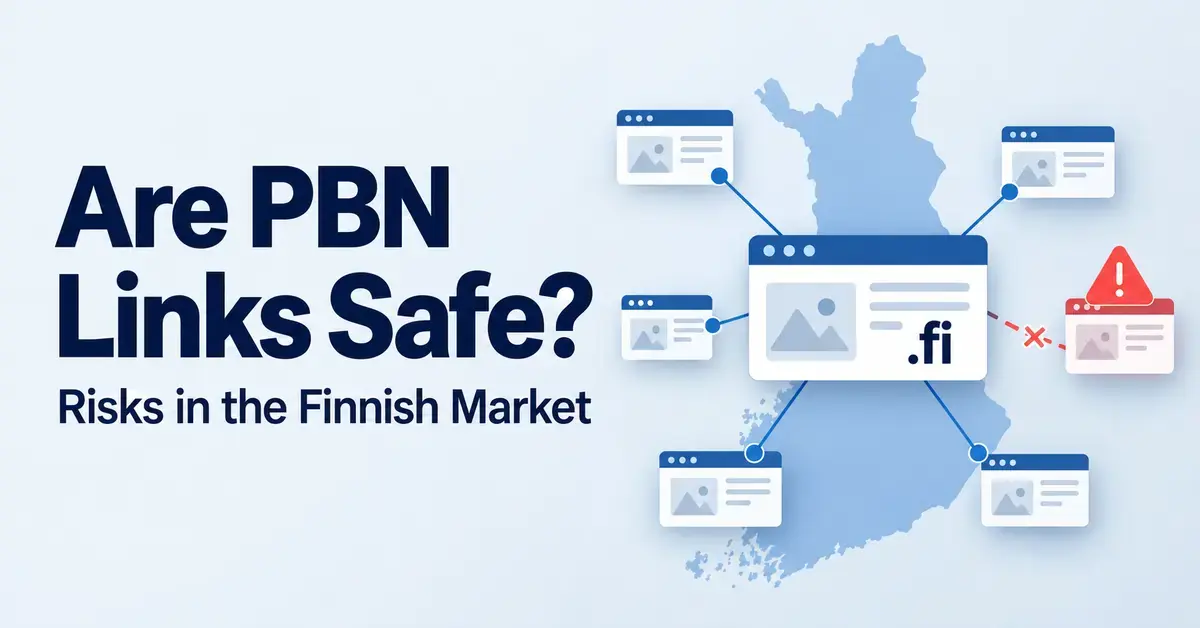
Private blog network (PBN) links are one of the most argued-over tactics in search engine optimisation (SEO), the practice of improving how a website ranks in Google. They promise fast ranking gains at low cost, which is exactly why offers to “boost your .fi site with 20 powerful backlinks” keep landing in the inboxes of Finnish businesses and international brands. So are PBN links safe? The honest answer is no: they violate Google’s rules, Google is increasingly good at detecting them, and the downside ranges from wasted money to a ranking collapse. This guide explains what a PBN actually is, how Google finds them, what the penalties look like, and why the small Finnish-language web makes these networks even easier to catch than in larger markets.
Key Points
- PBN links are not safe: they breach Google’s link spam policy because they exist only to manipulate rankings.
- Detection has improved: since the December 2022 SpamBrain update, Google targets both link buyers and networks that pass links.
- Most PBN links are ignored, not just penalised: Google often “nullifies” them, so you pay for links that pass no value.
- Footprints give networks away: shared IPs, nameservers, tracking codes, templates and outbound patterns connect the sites.
- Finland raises the risk: a small Finnish-language web and rejection of machine-translated content make footprints stand out.
- Safer route: earn editorial links through guest posting, digital PR and quality outreach instead.
What is a private blog network (PBN)?
A private blog network is a group of websites owned or controlled by one person or company for the single purpose of linking to a “money site” and pushing it up the rankings. A backlink is simply a link from one website to another, and Google historically treated each backlink as a vote of confidence. A PBN manufactures those votes artificially: instead of earning links from independent publishers, the operator builds or buys a stable of sites they secretly control and points the links wherever they want.
Many PBN domains are expired websites that once belonged to a real business, a school or a newspaper. Because those domains already had genuine backlinks and authority, operators re-register them, put thin content back on top, and reuse the leftover “link equity” — the ranking value passed through a link. On the surface each site looks like an ordinary blog. Underneath, the network exists only to manipulate search results.
How a PBN is supposed to work
The theory is straightforward. The operator controls, say, 30 sites. Each one publishes an article that links to the client’s page using keyword-rich anchor text — the clickable words in a link, such as “cheap flights Helsinki”. Because the operator owns every site, they can place any link with any anchor text on demand, no outreach required. For a while this can move rankings, which is why the tactic refuses to die.
PBN links versus genuine editorial links
The difference is intent and control. A genuine editorial link is given freely by an independent publisher because your content is worth citing; you cannot dictate it. A PBN link is placed by someone who controls both ends of the transaction purely to influence Google. Google’s systems are designed to tell these apart, and a link you can buy on demand with your own anchor text is the exact pattern they look for. If you want to judge whether a Finnish site is a real publisher or a disguised network property, our guide on how to evaluate Finnish websites walks through the signals.
Are PBN links safe? The short answer
No — PBN links are not safe, and the risk has grown, not shrunk. There are three separate problems. First, PBNs breach Google’s spam policies, so any ranking benefit is against the rules and can be removed at any time. Second, Google’s detection has improved sharply since 2022, meaning links you paid for can quietly stop counting. Third, if a network you rely on is de-indexed or penalised, every site linking from it loses value at once, so the damage tends to arrive in a sudden batch rather than a gentle decline. Even in the “best” case where you avoid a penalty, you are usually paying for links that Google has already learned to ignore.
Why Google treats PBNs as a link scheme
Google classifies PBNs as a link scheme because they exist only to manipulate rankings, which is the exact behaviour its link spam policy prohibits. A “link scheme” is Google’s term for any attempt to create links primarily to influence search results rather than to help readers.
What Google’s spam policies actually say
Google’s link spam policy defines the problem as “creating links to or from a site primarily for the purpose of manipulating search rankings.” Its published examples include buying or selling links that pass ranking credit, exchanging goods or money for links, native advertising or advertorials with ranking-credit links, and repeated template or footer links spread across many sites. A PBN ticks several of these boxes at once. Google does allow paid and sponsored links — but only when they are marked with a rel=”nofollow”, rel=”sponsored” or rel=”ugc” attribute, which tells Google not to pass ranking value. PBN links are, by design, followed links meant to pass value, so they are not compliant. If you are unsure where the line sits, our overview of paid links and Google’s rules in Finland covers the disclosure requirements in detail.
SpamBrain and how detection changed
In December 2022 Google rolled out a link spam update powered by SpamBrain, its machine-learning spam-detection system. The important change was that SpamBrain began identifying not just sites buying links but also sites whose main purpose is passing outgoing links — which is precisely what a PBN does. Google’s usual response is to “nullify” these links: rather than always issuing a penalty, its algorithms simply ignore the links so they pass no value. Google has ignored many manipulative links automatically since the Penguin 4.0 update in 2016. The practical result is that a modern PBN link often does nothing at all, even before any human at Google looks at it.
How Google detects PBN footprints
Google detects PBNs by spotting “footprints” — technical and editorial patterns that reveal separate-looking sites are actually run by one operator. A single footprint is rarely fatal, but networks tend to repeat themselves, and once several sites share the same fingerprints the whole cluster is easy to read as one machine. Common footprints include:
- Shared hosting and IP addresses: multiple network sites resolving to the same IP address or the same Class-C subnet (a block of closely related IPs) is one of the clearest giveaways.
- Shared nameservers or registrar patterns: the same DNS setup or WHOIS registration details across supposedly unrelated domains.
- Reused tracking codes: the same Google Analytics or Google Tag Manager ID on the network sites and the money site directly connects them.
- Duplicated design and content: the same theme, template, plugins or spun, low-quality articles across many domains.
- Identical outbound link patterns: the same handful of money sites linked from every property, often with the same optimised anchor text.
- Thin or abandoned content: expired domains revived with filler posts that exist only to hold a link.
What happens when a PBN gets caught
When Google catches a PBN, the consequence is either a quiet loss of ranking value or a visible penalty — and you often cannot tell which until your traffic moves. The two mechanisms work very differently.
Algorithmic devaluation
Algorithmic devaluation is the silent outcome: Google’s systems simply stop counting the links. There is no notification and no message in Google Search Console (Google’s free dashboard for site owners). Rankings that were propped up by the network drift back down, sometimes weeks or months later, and because nothing was “penalised” it can be hard to diagnose why. This is now the most common result for PBN links.
Manual actions
A manual action is the louder outcome: a human reviewer at Google flags the site for “unnatural links”, and you receive a notice in Search Console. Rankings and traffic can drop sharply. Recovering means removing or disavowing the offending links — the disavow tool tells Google to ignore specific backlinks — and then submitting a reconsideration request explaining what you cleaned up. That process can take weeks and does not guarantee a full recovery, which is a heavy price for links that were supposed to save time.
Why PBN links are especially risky in the Finnish market
PBN links are riskier in Finland than in large English-language markets because the Finnish web is small, which makes footprints stand out. Google handled roughly 85% of searches in Finland in 2026, so its judgement effectively decides visibility, and there are far fewer Finnish-language sites for a network to hide among than there are English ones.
Finnish is a Uralic language unrelated to Swedish or English, so content cannot be recycled across borders and machine-translated Finnish reads badly — real publishers reject it and readers notice immediately. A network trying to produce dozens of “independent” Finnish blogs therefore either reuses awkward translated text (an obvious footprint) or pays for genuine native writing (expensive, defeating the point). The pool of legitimate Finnish publishers is small enough that a cluster of suddenly active, thin .fi blogs all linking to the same handful of money sites is conspicuous. Because so many PBNs cluster around high-value niches, this matters most in competitive verticals such as iGaming; our page on casino link building in Finland covers those pressures specifically.
Common mistakes people make with PBNs
The biggest mistake is assuming a PBN link is “safe if it looks natural” — the whole model is unnatural, and the details that are supposed to hide it are exactly what Google indexes. Recurring errors include:
- Trusting a seller’s “private, undetectable network” claim. If a stranger can sell you access, it is not private, and other buyers leave the same footprints on it.
- Chasing high Domain Rating (DR) numbers. DR is a third-party score, not a Google metric; an expired domain can show high DR while passing no real value.
- Over-optimising anchor text. Pointing many links with the same exact-match keyword is one of the strongest manipulation signals.
- Putting all links on one network. If it is de-indexed, everything drops together instead of one bad link fading out.
- Ignoring the content around the link. A link inside thin, AI-spun or off-topic filler carries the footprint with it.
Many of these overlap with wider errors we cover in our guide to common link building mistakes in Finland.
Safer alternatives to PBN links
The safer alternative to PBN links is to earn links from real, independent Finnish sites through methods Google actively rewards — mainly editorial guest posting, digital PR and quality-driven outreach. These take longer than buying a network placement, but the links keep their value instead of waiting to be nullified. Two starting points are guest posting in Finland, where you contribute genuinely useful content to established Finnish publishers, and digital PR in Finland, where newsworthy stories and data earn coverage and links from Finnish media. The table below compares the main options at a glance.
Link Building Options Compared
| Method | How it works | Google-rule risk | Durability of the link |
|---|---|---|---|
| PBN links | Links placed on sites the operator secretly controls, with chosen anchor text | High — a prohibited link scheme | Low — often nullified or lost when the network is caught |
| Editorial guest posting | Genuinely useful articles contributed to independent Finnish publishers | Low when content-led and not paid for placement | High — stays live on a real site |
| Digital PR | Newsworthy data or stories that earn media coverage and links | Low — links are freely given | High — authoritative, lasting coverage |
| Disclosed paid / sponsored links | Paid placements marked rel=”sponsored” or rel=”nofollow” | Low — compliant when correctly disclosed | Moderate — valid, but passes no ranking credit by design |
| Business directories & citations | Listings in reputable, relevant Finnish directories | Low for quality directories; higher for bulk low-value ones | Moderate — useful for trust and local signals |
How to spot a PBN link offer before you buy
You can usually spot a PBN offer by the sales pitch itself: it emphasises control, speed and volume rather than genuine editorial fit. Warning signs include a promise that you choose the exact anchor text and target page, a fixed price per link with no editorial review, vague site names hidden behind “a network of high-authority sites”, guaranteed placement within days, and a refusal to name the actual domains before payment. Legitimate publishers care whether your content suits their audience; a network only cares that you pay. When you do get a domain name, check whether the site has a real audience, ongoing original content and a plausible history — the same checks you would run to assess any Finnish site before accepting a link from it. If in doubt about a specific offer, you can always ask for a second opinion before spending money.
What to do if you already have PBN links pointing to your site
If you already have PBN links, first assess the damage, then decide between removal and disavowal — do not panic-delete everything at once. Export your backlink profile from Google Search Console or a reputable third-party tool and identify the network links. Where you can, ask for the worst links to be removed. For links you cannot remove and genuinely believe are harmful, Google’s disavow tool lets you ask Google to ignore them; use it carefully, because disavowing good links by mistake can cost you rankings. If you have a manual action, clean up the links and then file a reconsideration request. Going forward, replace the lost “authority” with genuine editorial links rather than another network, so the recovery holds.
This article is general information about how PBN links interact with Google’s guidelines, not legal advice or a guarantee of ranking outcomes; search algorithms change, and results depend on your whole site and market.
Sources
- Google Search Central — Spam policies for Google web search (link spam)
- Search Engine Land — Google releases December 2022 link spam update (SpamBrain)
- Search Engine Journal — Google December 2022 link spam update
- Search Engine Land — What are PBNs? Risks and SEO implications
- StatCounter — Search engine market share in Finland
Frequently asked questions (FAQ)
Are PBN links against Google’s rules?
Yes. Google’s link spam policy prohibits creating links primarily to manipulate rankings, and a private blog network exists only for that purpose. Google does not name “PBN” in every policy document, but the tactics a PBN uses — buying or placing followed links you control, spread across many sites — are listed examples of link schemes.
Can Google really detect a well-built PBN?
Increasingly, yes. Since the December 2022 link spam update, Google’s SpamBrain system targets both sites buying links and sites that exist to pass links outward. Networks fail because they repeat patterns — shared hosting, reused tracking codes, duplicated templates and identical outbound links — that machine learning is good at spotting, especially in a small market like Finland.
Will one PBN link get my site penalised?
A single link is unlikely to trigger a manual penalty on its own; more often Google simply ignores it, so it passes no value. The real risk builds up with volume and reliance: many manipulative links, over-optimised anchor text, or dependence on one network can lead to algorithmic devaluation or, in clearer cases, a manual action.
What is the difference between nullifying a link and penalising a site?
Nullifying means Google quietly stops counting a link, so it no longer helps you — there is no notification. A penalty (manual action) is an active flag on your site for unnatural links, shown in Google Search Console, and it can pull rankings down until you clean up and request reconsideration. Nullification is now the most common outcome for PBN links.
What should I use instead of PBN links in Finland?
Earn links from real, independent Finnish publishers through editorial guest posting, digital PR, useful content that others cite, and properly disclosed sponsored placements. These methods are slower than buying a network link but keep their value instead of being ignored or penalised, which matters in a small market where Google decides most of the visibility.
